
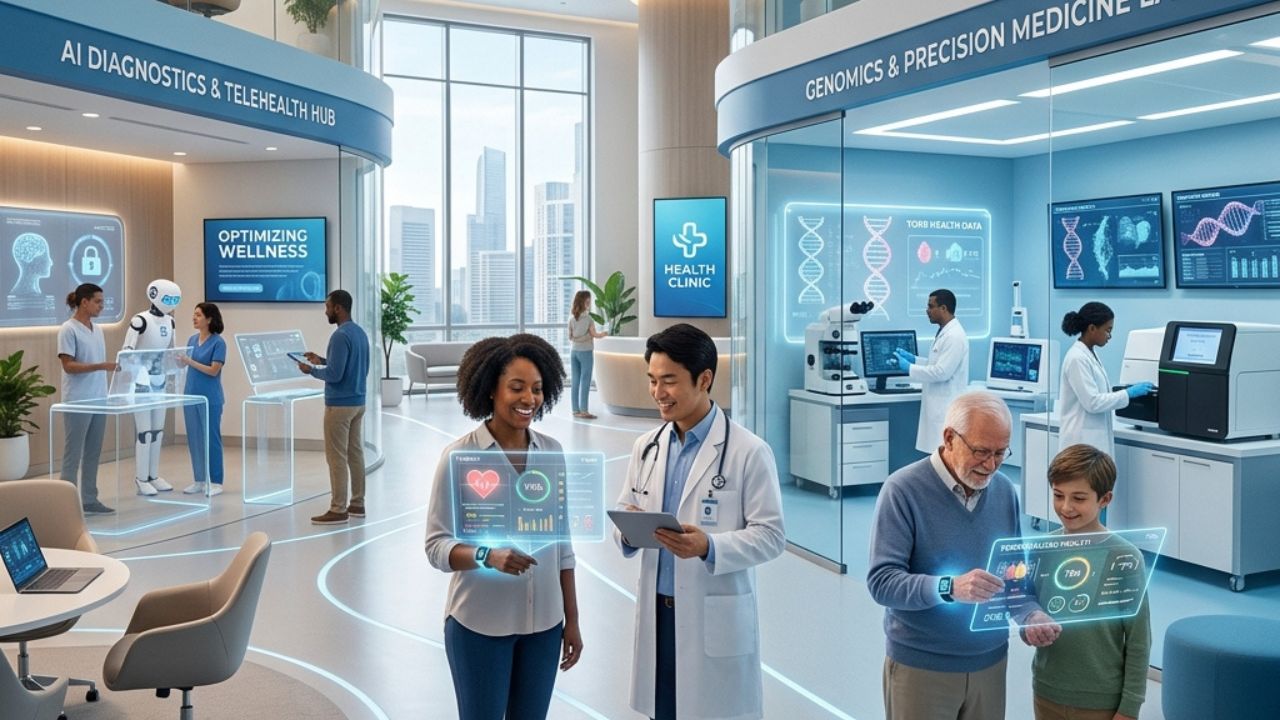
Personalized healthcare uses your genetics, lifestyle, and real-time health data to tailor prevention and treatment to you specifically. Powered by AI, genomics, and wearables, it promises better outcomes, lower costs, and more proactive care—though challenges around privacy, equity, and regulation remain.
Healthcare has long operated on averages. A drug gets approved because it works for most people in a clinical trial. A treatment plan follows a standard protocol built around the “typical” patient. But you are not an average—and the medicine of the next decade is finally catching up to that reality.
Personalized healthcare flips the traditional model. Instead of treating the disease the same way for everyone, it treats the person: their genes, their environment, their daily habits, and the constant stream of data their bodies generate. This shift is already reshaping how doctors diagnose conditions, prescribe medications, and prevent illness before it starts.
In this guide, you’ll learn what personalized healthcare actually means, the technologies driving it forward, its core benefits and real challenges, and what the next 5 to 10 years might look like. Whether you’re a patient, a provider, or a policymaker, understanding this transformation will help you navigate the future of medicine.
What is personalized healthcare?
Personalized healthcare—sometimes called precision medicine—is an approach that customizes medical decisions, treatments, and prevention strategies to the individual patient. Rather than relying on one-size-fits-all protocols, it accounts for genetic makeup, lifestyle, environment, and personal health history.
The concept isn’t entirely new. Doctors have always adjusted care based on a patient’s age, weight, or family history. What’s changed is the depth of detail now available. A century ago, physicians worked with symptoms and basic observation. The discovery of blood types in the early 1900s offered an early glimpse of biological individuality. Then came the Human Genome Project, completed in 2003, which mapped all human genes and opened the door to treatment based on DNA.
Today, the promise of personalization runs deeper than ever. We can sequence a tumor to find its specific mutations, predict a patient’s risk of disease decades in advance, and monitor health continuously through devices worn on the wrist. The goal is simple: the right treatment, for the right person, at the right time.
What technologies are driving personalized healthcare forward?
Several breakthroughs are converging to make personalized medicine practical and scalable. No single technology does the work alone—their combined power makes the difference.
How are AI and machine learning used in diagnostics and treatment?
Artificial intelligence and machine learning analyze enormous datasets far faster than any human team. In diagnostics, AI models can detect patterns in medical images—spotting early signs of cancer in a mammogram or identifying diabetic retinopathy in an eye scan—often with accuracy that rivals specialists.
In treatment, machine learning helps match patients to the therapies most likely to work for them. By learning from thousands of past cases, these systems can predict how a specific patient might respond to a drug, reducing the trial-and-error that often frustrates both doctors and patients.
What role do genomics and ‘omics’ technologies play?
Genomics studies a person’s complete set of DNA. Related fields—collectively called “omics”—examine proteins (proteomics), metabolites (metabolomics), and other biological molecules. Together, they reveal a detailed molecular portrait of an individual.
This matters most in areas like cancer care. Tumor sequencing identifies the exact mutations driving a patient’s disease, allowing oncologists to choose targeted therapies. Pharmacogenomics, another branch, studies how genes affect a person’s response to drugs—helping doctors avoid prescriptions that won’t work or could cause harm.
How do wearables and remote monitoring fit in?
Wearable devices—smartwatches, continuous glucose monitors, and fitness trackers—generate a constant flow of health data outside the clinic. Heart rate, sleep patterns, blood oxygen, and activity levels all become measurable in real time.
This continuous monitoring shifts healthcare from occasional snapshots to an ongoing picture. A cardiologist can spot an irregular heart rhythm days before a patient feels symptoms. Remote monitoring also supports patients with chronic conditions, letting them manage their health from home while staying connected to their care team.
Why is big data essential to personalized care?
Personalized healthcare runs on data—and lots of it. Big data and predictive analytics combine information from genetics, medical records, wearables, and population health studies to forecast risks and outcomes.
When a system can analyze millions of patient records, it can identify which individuals are most likely to develop a condition, then recommend early action. This predictive power turns healthcare from reactive to proactive.
What are the key pillars of personalized healthcare?
Four foundations support the personalized model, each addressing a different stage of the patient journey.
Precision medicine tailors treatment to a person’s genetic, environmental, and lifestyle factors. Instead of prescribing the standard dose of a standard drug, doctors select therapies designed for that individual’s biology.
Preventive care focuses on stopping illness before it begins. Through risk assessment and early intervention, providers can flag a patient’s elevated risk for heart disease or diabetes and act early—through lifestyle changes, screening, or medication.
Patient engagement puts people in charge of their own health. Digital tools, apps, and educational resources help individuals understand their data and make informed choices. An engaged patient is far more likely to follow a treatment plan and catch problems early.
Integrated care models bring together the many parts of the healthcare system—primary care, specialists, mental health, and social services—into a coordinated whole. This holistic approach treats the whole person rather than a single symptom in isolation.
What are the benefits of personalized healthcare?
The advantages of this approach reach patients, providers, and entire health systems.
- Improved outcomes: Treatments matched to a patient’s biology tend to work better and cause fewer side effects. Cancer patients on targeted therapies, for example, often respond more strongly than those on conventional chemotherapy alone.
- Lower costs: Prevention and efficiency reduce waste. Catching disease early, avoiding ineffective treatments, and cutting hospital readmissions all save money over time.
- Higher patient satisfaction: When people feel their care is built around them—and when they have tools to participate—they trust the system more and stay more engaged.
- Smarter resource use: Predictive analytics help providers focus attention where it’s needed most, allocating limited resources more effectively.
These benefits come with an important caveat: they depend on responsible handling of sensitive personal data, which brings us to the challenges.
What are the challenges of personalized healthcare?
For all its promise, personalized healthcare faces real obstacles that must be addressed honestly.
Data security and privacy sit at the top of the list. Genetic and health data are deeply personal. A breach could expose information that affects insurance, employment, or family members. Protecting this data requires strong safeguards and clear consent.
Regulatory hurdles slow progress. Many personalized treatments and AI tools move faster than the rules designed to oversee them. Regulators must balance speed with safety, and standardization across regions remains incomplete.
Accessibility and equity raise serious concerns. Advanced genomic testing and cutting-edge therapies can be expensive. Without deliberate effort, personalized medicine risks widening the gap between those who can afford it and those who can’t.
The evolving role of healthcare professionals also demands attention. Doctors and nurses must learn to work alongside AI, interpret genomic reports, and guide patients through a flood of data. Their human judgment remains essential—technology supports clinicians, it doesn’t replace them.
What do real-world examples of personalized healthcare look like?
Personalized medicine is no longer theoretical. Several applications already deliver results.
In oncology, tumor genetic testing routinely guides treatment. Drugs like trastuzumab (Herceptin) work specifically for breast cancer patients whose tumors overexpress the HER2 protein—a clear case of matching therapy to biology.
CAR T-cell therapy offers another striking example. This treatment reprograms a patient’s own immune cells to attack their cancer, customizing the therapy to the individual. It has produced remarkable results in certain blood cancers.
Pharmacogenomic testing is also spreading into everyday care. Some health systems now test patients before prescribing certain drugs—from blood thinners to antidepressants—to predict how they’ll respond and adjust the dose accordingly.
What does the future of personalized healthcare look like?
The next 5 to 10 years will likely accelerate these trends and introduce new ones.
Genomic sequencing will become cheaper and more routine, possibly part of standard checkups. AI tools will grow more sophisticated, predicting health risks earlier and recommending interventions with greater precision. Digital health platforms will increasingly weave together data from wearables, records, and genetics into a single, usable view of a person’s health.
Expect a stronger shift toward prevention. As predictive models improve, the focus will move from treating sickness to maintaining wellness. Care will also become more decentralized—more monitoring and treatment will happen at home rather than in hospitals.
Globally, the impact could be profound. Lower-cost diagnostic tools and telehealth could extend personalized care to regions that have long lacked access. Realizing that potential, though, depends on closing the equity gap rather than deepening it.
Bringing personalized medicine into focus
Personalized healthcare represents a fundamental rethinking of medicine—from treating the average patient to treating the actual one. AI, genomics, wearables, and big data are making this vision practical, with benefits that include better outcomes, lower costs, and more engaged patients. At the same time, the path forward runs through genuine challenges around privacy, regulation, and fairness.
The transformation won’t happen on its own. Patients can take an active role by tracking their health and asking informed questions. Providers can build the skills to combine clinical judgment with new tools. Policymakers can craft rules that protect privacy and expand access at the same time. Each group has a part to play in shaping a system that serves everyone—not just the average.
Frequently asked questions
What is the difference between personalized medicine and precision medicine?
The terms are often used interchangeably. Both describe tailoring care to the individual. “Precision medicine” tends to emphasize the role of genetics and molecular data in selecting treatments, while “personalized healthcare” is a broader term covering prevention, engagement, and integrated care as well.
Is personalized healthcare expensive?
It can be, especially advanced genomic testing and targeted therapies. However, costs are falling quickly as technology matures. Over time, the prevention and efficiency built into personalized care can reduce overall healthcare spending by avoiding ineffective treatments and catching disease early.
Is my genetic and health data safe?
Data security is one of the biggest challenges in this field. Reputable providers use encryption, strict access controls, and consent requirements to protect sensitive information. Before sharing genetic data, ask how it will be stored, who can access it, and whether it may be shared with third parties.
Who benefits most from personalized healthcare?
Patients with complex or chronic conditions—such as cancer, diabetes, or heart disease—often see the greatest benefit, since tailored treatments and continuous monitoring make a real difference. That said, preventive and predictive tools can benefit nearly anyone by catching risks early.
Will AI replace doctors in personalized healthcare?
No. AI supports clinicians by analyzing data and spotting patterns, but human judgment, empathy, and ethical decision-making remain central to care. The future points to doctors working alongside AI, not being replaced by it.