
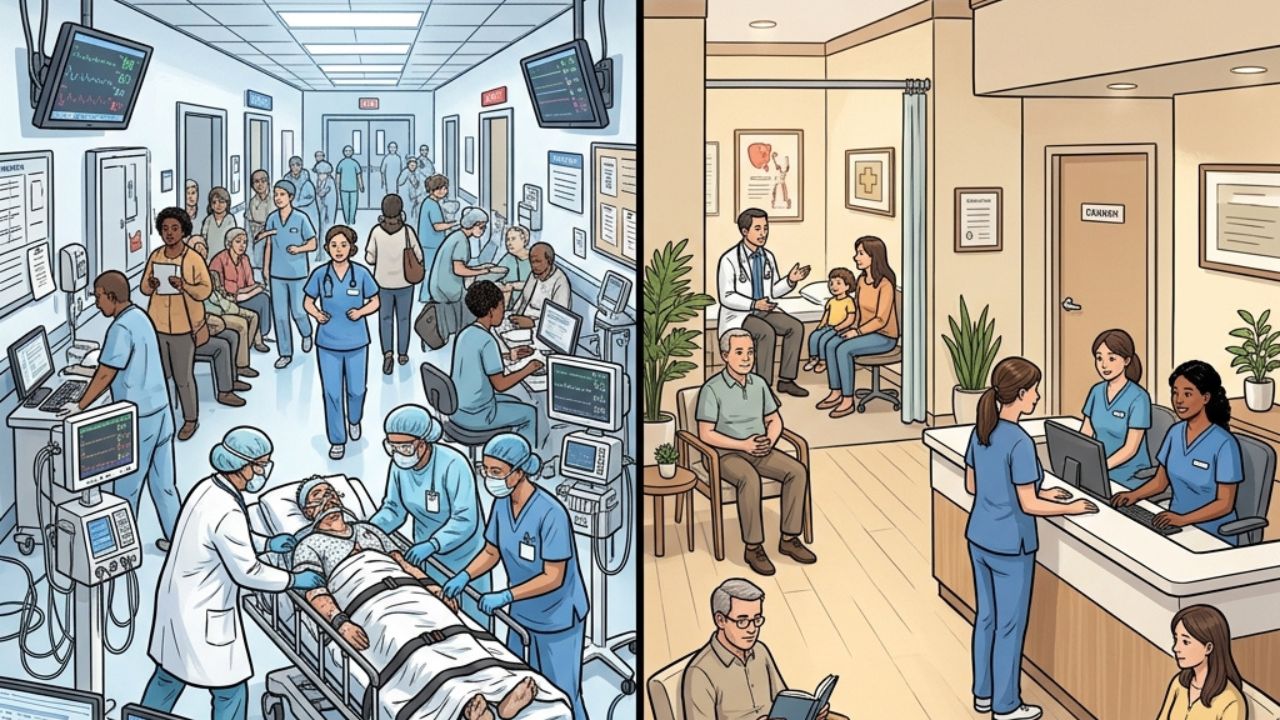
For life-threatening emergencies—chest pain, stroke symptoms, severe injuries—go to a hospital emergency room immediately. For non-life-threatening conditions like minor fractures, infections, or flu symptoms, urgent care centers offer faster, more affordable treatment. When in doubt, call your primary care physician first.
Choosing between a hospital and an urgent care center sounds straightforward—until you’re the one in pain, trying to make that call at 9 p.m. on a Sunday. The wrong choice can mean hours of unnecessary waiting, a bill far larger than expected, or worse, delayed treatment for something serious.
The good news? Once you understand how each setting works, the decision becomes much clearer. Hospitals and urgent care centers serve distinct purposes, and knowing the difference can save you time, money, and stress when it matters most.
This guide breaks down exactly what each option offers, how they compare on cost and wait times, and how to quickly assess which one is right for your situation.
Hospitals: Comprehensive Care for Serious Conditions
What Makes Emergency Rooms Different From All Other Healthcare Settings?
Hospital emergency rooms (ERs) are built for one thing: handling the cases that no other facility can. They operate 24/7 and are staffed by emergency medicine physicians, specialists, nurses, and support teams equipped to manage virtually any medical crisis.
ERs have immediate access to advanced imaging (CT scans, MRIs), surgical suites, intensive care units, and on-call specialists across every major discipline. That infrastructure makes them the only appropriate destination for life-threatening conditions.
Conditions that require immediate ER attention include:
- Chest pain or pressure (possible heart attack)
- Sudden numbness, confusion, or difficulty speaking (possible stroke)
- Severe allergic reactions (anaphylaxis)
- Difficulty breathing
- Loss of consciousness
- Major trauma, such as serious car accident injuries
- Uncontrolled bleeding
- Seizures
- Severe abdominal pain
If any of these apply, call 911. Don’t drive yourself—paramedics can begin life-saving treatment on the way.
What Should You Expect During an ER Visit?
ERs use a triage system, meaning patients are seen in order of severity, not arrival time. A patient with a sprained ankle will wait significantly longer than someone presenting with stroke symptoms—by design.
Once triaged, you’ll be assessed, stabilized, and either treated and discharged or admitted for inpatient care. The process is thorough, but it takes time. According to the Centers for Disease Control and Prevention (CDC), the average ER wait time in the United States is about 40 minutes before a physician sees you, with total visit times often exceeding two to four hours.
When Is Hospital Admission Necessary?
Not every hospital visit ends in discharge. Inpatient admission becomes necessary when a patient requires ongoing monitoring, surgery, or treatments that can’t be completed in a single visit. Conditions like severe infections, post-surgical recovery, heart failure management, and major trauma often require hospital stays ranging from a single night to several weeks.
Beyond emergency care, hospitals also offer scheduled outpatient procedures and specialist consultations—services your primary care physician might refer you to when a condition exceeds the scope of a standard clinic visit.
What Are the Advantages and Disadvantages of Hospital Emergency Care?
Advantages:
- Comprehensive, around-the-clock care for any condition
- Access to specialists, surgeons, and advanced diagnostics
- Equipped to handle life-threatening emergencies
- Immediate access to intensive care if needed
Disadvantages:
- Significantly higher costs than urgent care
- Long wait times for non-emergency conditions
- ERs can be overwhelming, especially during peak hours
- May result in high out-of-pocket expenses depending on insurance coverage
Urgent Care Centers: A Convenient Middle Ground
What Is an Urgent Care Center, and What Conditions Does It Treat?
Urgent care centers emerged to address a gap in the healthcare system—conditions too urgent to wait for a primary care appointment, but not serious enough to justify an ER visit. They typically operate extended hours (evenings and weekends) and accept walk-in patients without an appointment.
Most urgent care centers are staffed by physicians, nurse practitioners, and physician assistants. They’re equipped to handle a wide range of non-life-threatening conditions, including:
- Minor cuts and lacerations requiring stitches
- Sprains and minor fractures
- Urinary tract infections (UTIs)
- Ear infections and sinus infections
- Flu and cold symptoms
- Mild asthma attacks
- Rashes and skin conditions
- Pink eye
Many urgent care centers also offer on-site X-rays, basic lab work, rapid strep and flu tests, and IV hydration. Some even provide occupational health services and physical examinations.
When Should You Choose Urgent Care Over the Emergency Room?
The simplest rule: if your condition is non-life-threatening but needs attention today, urgent care is likely your best option.
Consider urgent care when your primary care physician isn’t available, you need same-day treatment for a manageable illness or injury, and your symptoms are uncomfortable but stable. The cost savings alone can be significant. According to a 2017 study published in JAMA Internal Medicine, the average urgent care visit cost around $155, compared to an average ER visit cost exceeding $1,300.
What Are the Advantages and Disadvantages of Urgent Care Centers?
Advantages:
- Shorter wait times (average 15–30 minutes)
- Significantly lower cost than ER visits
- Convenient hours and walk-in availability
- Handles a broad range of common illnesses and injuries
Disadvantages:
- Cannot treat life-threatening emergencies
- Limited access to specialists and advanced imaging
- Varies in quality and services offered by location
- May not have access to your full medical history
Hospital vs. Urgent Care: How Do They Actually Compare?
How Does the Severity of Your Condition Determine Where You Should Go?
The single most important factor in deciding where to seek care is the severity of your condition. A helpful framework: if your symptoms could kill you or cause permanent damage within hours, go to the ER. If your symptoms are painful, disruptive, or worsening but not immediately dangerous, urgent care is the appropriate setting.
When in doubt, err on the side of caution. No one will fault you for going to the ER and discovering it wasn’t strictly necessary—but the reverse situation carries far greater risk.
How Do Wait Times and Costs Compare Between Hospitals and Urgent Care?
| Emergency Room | Urgent Care | |
|---|---|---|
| Average wait time | 40+ minutes (triage to physician) | 15–30 minutes |
| Average visit cost | $1,300–$2,500+ | $100–$200 |
| Hours | 24/7 | Typically 8 a.m.–8 p.m. |
| Insurance accepted | Most plans | Most plans, varies by location |
These differences are significant, particularly for the uninsured or underinsured. Using the ER for a minor infection or a sprained wrist can result in a bill ten times higher than the same visit at an urgent care center.
How Do Staffing and Equipment Differ Between Hospitals and Urgent Care Centers?
Hospitals maintain full departments of specialists—cardiologists, neurologists, orthopedic surgeons, and more—alongside surgical teams and ICU staff. They carry imaging equipment capable of detecting internal bleeding, tumors, and complex fractures.
Urgent care centers are staffed by generalist clinicians trained to identify and treat common conditions. Their equipment is more limited: X-rays for straightforward fractures, basic blood panels, and rapid diagnostic tests. For anything beyond that scope, a good urgent care provider will recognize the limits of their setting and refer or transfer you to an ER immediately.
How to Make the Right Decision in the Moment
How Can You Quickly Self-Assess Whether Your Situation Is an Emergency?
When symptoms strike, ask yourself three questions:
- Is this potentially life-threatening? Chest pain, loss of consciousness, difficulty breathing, sudden severe headache, signs of stroke—these require 911 or the ER, immediately.
- Is this worsening rapidly? Symptoms that deteriorate quickly—spreading redness suggesting infection, increasing abdominal pain, rising fever—lean toward ER or urgent care, depending on severity.
- Can this wait for a scheduled appointment? If your symptoms are mild, stable, and manageable, a call to your primary care physician to schedule a same-day or next-day appointment may be the most efficient choice.
Should You Call Your Primary Care Physician Before Going to Urgent Care or the ER?
Many primary care practices offer after-hours nurse lines or telehealth appointments, which can help triage your situation before you leave the house. A quick call can confirm whether your symptoms warrant an ER visit, guide you toward urgent care, or reassure you that home management is appropriate.
This step is especially valuable for people managing chronic conditions, where symptoms can be ambiguous. Your physician also has your full medical history—context that walk-in providers don’t have access to.
Frequently Asked Questions About Hospital vs. Urgent Care
Can urgent care centers treat broken bones?
Urgent care centers can treat many minor fractures—hairline fractures, non-displaced breaks in fingers or toes—using on-site X-rays and splinting. However, complex fractures, breaks involving joints, or fractures requiring surgical intervention need emergency or orthopedic hospital care.
Is urgent care cheaper than the ER if I have insurance?
Generally, yes. Most insurance plans apply higher copays and deductibles to ER visits than to urgent care visits. Some plans distinguish between ER copays ($150–$350 or more) and urgent care copays ($25–$75). Always check your plan’s details, as coverage varies significantly.
What if I go to urgent care and my condition turns out to be serious?
A reputable urgent care center will recognize conditions beyond its scope and facilitate a transfer to the nearest ER. They may also call ahead to the emergency room to provide relevant clinical information. If you arrive at urgent care and your condition is deteriorating rapidly, staff are trained to stabilize you and arrange emergency transport.
Can children be treated at urgent care centers?
Most urgent care centers treat patients of all ages, including children. Some centers specialize specifically in pediatric urgent care. For serious pediatric emergencies, a children’s hospital ER is the appropriate destination, as staff are trained specifically in pediatric emergency medicine.
What is the difference between freestanding ERs and urgent care centers?
Freestanding emergency rooms look similar to urgent care centers but operate as full emergency departments—often with ER-level pricing to match. They can handle true emergencies but typically cost as much as a hospital ER visit. Always confirm whether a facility is an urgent care center or a freestanding ER before your visit, particularly if cost is a concern.
The Bottom Line: Match Your Care Setting to Your Condition
The hospital ER and the urgent care center each serve a critical role in the American healthcare system. The ER exists for emergencies that cannot wait and cannot be managed anywhere else. Urgent care exists to make accessible, affordable treatment available for the vast majority of conditions that fall short of that threshold.
Getting this decision right isn’t about memorizing a list—it’s about honest self-assessment. When you feel confident the situation isn’t life-threatening, urgent care will almost always get you faster, more affordable care. When there’s genuine doubt about severity, the ER is the safer choice.
If you’re unsure, your primary care physician is your best first call. Building that relationship before a health crisis ensures you have a trusted resource to guide you when it matters most.