
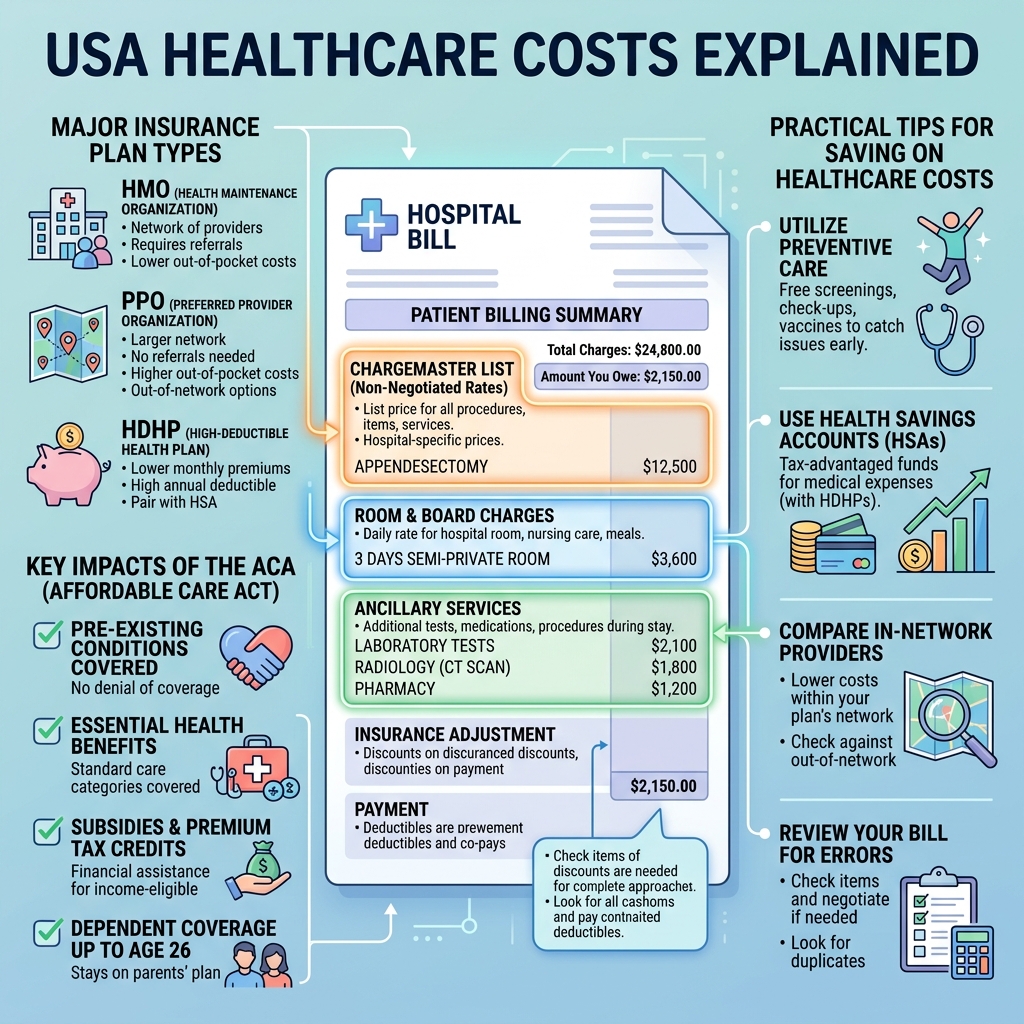
USA healthcare costs are among the highest in the world, driven by complex hospital billing systems, fragmented insurance structures, and hidden fees. This guide breaks down hospital bills, explains key insurance terms, and shares practical strategies to help Americans reduce their out-of-pocket healthcare expenses.
If you’ve ever opened a hospital bill and felt your stomach drop, you’re not alone. The United States spends more on healthcare per capita than any other developed nation—nearly $13,000 per person annually, according to the Kaiser Family Foundation (2023). Yet millions of Americans remain uninsured or underinsured, one unexpected diagnosis away from financial hardship.
Understanding how healthcare costs work in the U.S. isn’t just useful—it’s essential. From deciphering a hospital bill to choosing the right insurance plan, navigating this system without knowledge is like driving cross-country without a map. The good news? Once you understand the basics, you can make smarter decisions that protect both your health and your wallet.
This guide covers everything: how hospitals calculate what they charge, how insurance plans actually work, the hidden costs most people don’t see coming, and—most importantly—concrete strategies to reduce what you pay.
Deciphering Hospital Bills: What Are You Actually Paying For?
What is the “Chargemaster,” and why does it make hospital bills so confusing?
Every hospital maintains a document called a Chargemaster—a master list of prices for every service, procedure, medication, and supply the hospital offers. These prices are rarely what anyone actually pays, but they form the starting point for all billing negotiations between hospitals and insurers.
The Chargemaster exists in a kind of parallel pricing universe. A hospital might list a basic blood test at $400, while the negotiated rate with your insurer is $80, and the actual cost of providing that test is somewhere in between. For patients without insurance, Chargemaster prices can be brutally high, which is why uninsured patients often face the steepest bills despite having the least ability to pay.
What are the most common hospital charges?
A typical hospital bill may include:
- Room and board: Daily charges for your bed, nursing care, and general hospital services
- Procedures: Surgical fees, anesthesia, and related operating room costs
- Medications: Often marked up significantly from retail pharmacy prices
- Medical supplies: Individual items like gloves, syringes, and bandages can appear as separate line items
What are ancillary services, and how do they add to your bill?
Beyond the core charges, hospitals bill separately for ancillary services—lab work, radiology, imaging (like MRIs or CT scans), and specialist consultations. These are frequently billed by different departments or even third-party providers, which is why you might receive multiple bills from a single hospital visit.
How do you read an Explanation of Benefits (EOB)?
After a medical visit, your insurer sends an Explanation of Benefits (EOB)—a document that outlines what was billed, what the insurer covered, and what you owe. It’s not a bill, but it’s your most important tool for catching errors.
Key sections to review:
- Amount billed: What the provider charged
- Plan discount: The negotiated reduction your insurer secured
- Plan paid: What your insurance covered
- Your responsibility: What you owe after discounts and coverage
How can you spot and dispute billing errors on a hospital bill?
Medical billing errors are surprisingly common. A 2023 study from JAMA Network Open found that billing errors occur in a significant percentage of hospital claims. Common mistakes include duplicate charges, incorrect billing codes, and charges for services never received.
If something looks off, request an itemized bill directly from the hospital’s billing department. You have the right to dispute any charge, and many hospitals have financial counselors who can walk you through the process. Don’t hesitate to ask—hospitals negotiate bills far more often than most patients realize.
Navigating the Insurance Maze: Plans, Premiums, and Pitfalls
What are the different types of health insurance plans in the U.S.?
Choosing a health insurance plan starts with understanding the main plan types:
- HMO (Health Maintenance Organization): Requires you to use a network of doctors and get referrals to see specialists. Lower premiums, but less flexibility.
- PPO (Preferred Provider Organization): More flexibility to see out-of-network providers, but higher premiums.
- EPO (Exclusive Provider Organization): Like an HMO, but without referral requirements.
- POS (Point of Service): A hybrid of HMO and PPO features.
- HDHP (High-Deductible Health Plan): Lower premiums with higher deductibles, often paired with a Health Savings Account (HSA).
The right plan depends on your health needs, budget, and how often you see doctors or specialists.
What do key insurance terms like deductibles and co-insurance actually mean?
These terms trip up even experienced insurance holders:
- Premium: Your monthly payment to maintain coverage, regardless of whether you use healthcare services
- Deductible: The amount you pay out-of-pocket before your insurance starts contributing
- Co-pay: A fixed fee you pay per visit or prescription
- Co-insurance: After meeting your deductible, the percentage of costs you still share with your insurer (e.g., 80/20 means insurance covers 80%, you cover 20%)
- Out-of-pocket maximum: The most you’ll pay in a plan year—after reaching this limit, your insurer covers 100% of covered services
How has the Affordable Care Act (ACA) shaped healthcare costs?
The Affordable Care Act (ACA), signed into law in 2010, expanded access to health insurance through several mechanisms: the creation of insurance marketplaces, Medicaid expansion in participating states, and subsidies for lower-income individuals. The ACA also eliminated lifetime coverage limits and required insurers to cover pre-existing conditions.
As of 2024, enhanced subsidies introduced under the American Rescue Plan remain in effect, making marketplace plans more affordable for many Americans. You can explore plans at healthcare.gov.
What is the difference between employer-sponsored and individual health insurance?
Employer-sponsored plans are generally the most cost-effective option when available, since employers typically cover a significant portion of premiums. The average employer-sponsored family premium exceeded $23,000 in 2023, with employees contributing roughly $6,500 of that, according to the Kaiser Family Foundation.
Individual plans, purchased through the ACA marketplace or directly from insurers, give you more control but often come at a higher cost. They’re the primary option for self-employed individuals and those whose employers don’t offer coverage.
Who qualifies for Medicare and Medicaid?
Medicare is a federal program covering Americans 65 and older, as well as some younger individuals with disabilities. It’s divided into parts: Part A (hospital insurance), Part B (medical insurance), Part C (Medicare Advantage), and Part D (prescription drug coverage).
Medicaid is a joint federal-state program providing coverage to low-income individuals and families. Eligibility rules vary by state, but the ACA’s Medicaid expansion has extended coverage to millions of additional Americans in participating states.
How can you manage prescription drug costs through your insurance plan?
Prescription coverage is typically structured in tiers, from generic drugs at the lowest cost to specialty medications at the highest. Each insurer maintains a formulary—a list of covered drugs. Before filling a prescription, check whether your medication is on your plan’s formulary and at what tier, as this directly affects your co-pay.
Beyond the Basics: Hidden Costs and Unexpected Expenses
What is surprise billing, and how does the No Surprises Act protect patients?
Surprise billing occurs when patients unknowingly receive care from out-of-network providers—often during emergencies when they have no choice. The result can be bills far exceeding in-network rates.
The No Surprises Act, which took effect in January 2022, offers significant protections. It limits out-of-pocket costs for emergency services to in-network rates and requires providers to give advance notice when out-of-network care is involved.
Why do diagnostic test costs vary so dramatically?
The price of an MRI, for example, can range from $400 to over $3,500 depending on the facility, location, and whether it’s hospital-based or at a standalone imaging center. These cost differences reflect facility fees, overhead, and the lack of standardized pricing in U.S. healthcare—not necessarily differences in quality.
Emergency Room vs. Urgent Care: Which should you choose to save money?
Emergency rooms are equipped to handle life-threatening situations—and priced accordingly. An ER visit costs an average of $1,500 or more, compared to $150–$200 at an urgent care clinic for non-emergency conditions.
Use urgent care for minor issues: cuts, ear infections, mild fevers, and similar concerns. Reserve the emergency room for chest pain, difficulty breathing, severe injuries, and other genuine emergencies.
What does health insurance typically not cover?
Standard health insurance plans generally exclude long-term care—meaning nursing home stays, assisted living, and in-home care for chronic conditions or disabilities. Long-term care insurance is a separate product, and planning for these costs is an often-overlooked aspect of financial and health planning.
Strategies for Savings: Practical Ways to Reduce Your Healthcare Costs
How does preventive care help you save money on healthcare?
Under the ACA, most preventive care services—annual physicals, vaccinations, screenings for conditions like diabetes and cancer—are covered at no cost when you use an in-network provider. Taking advantage of these services catches health issues early, when they’re far less expensive to treat.
Generic vs. brand-name drugs: which saves you more money?
Generic drugs contain the same active ingredients as brand-name versions and meet the same FDA standards for safety and efficacy. They typically cost 80–85% less than their brand-name counterparts, according to the FDA. When a generic is available, it’s almost always the smarter financial choice.
How can you price shop for medical procedures?
Healthcare pricing transparency tools have expanded significantly. Websites like Healthcare Bluebook, FAIR Health, and hospital price transparency portals (now required by federal law) let you compare costs for procedures in your area before committing to a provider.
Always ask for a cost estimate before elective procedures. Many providers will give you a written estimate, and some hospitals offer prompt-pay discounts if you pay upfront.
Can you actually negotiate a hospital bill?
Yes—and more successfully than most people expect. Hospitals regularly reduce bills for patients who ask. Strategies include:
- Requesting an itemized bill and checking for errors
- Asking about financial assistance programs (many hospitals are required to offer charity care)
- Proposing a lump-sum settlement for a reduced amount
- Setting up an interest-free payment plan
Persistence matters. Hospital billing departments are accustomed to negotiation, and even a modest reduction on a large bill can save you hundreds or thousands of dollars.
What is a Health Savings Account (HSA), and how does it reduce your healthcare costs?
An HSA is a tax-advantaged savings account available to individuals enrolled in a High-Deductible Health Plan (HDHP). Contributions are tax-deductible, growth is tax-free, and withdrawals for qualified medical expenses are also tax-free—a triple tax advantage.
In 2024, the HSA contribution limit is $4,150 for individuals and $8,300 for families. Funds roll over year to year with no “use it or lose it” rule, making HSAs a powerful long-term tool for managing healthcare expenses.
Take Control of Your Healthcare Costs
USA healthcare costs are genuinely complex—but they’re not impenetrable. The system rewards patients who ask questions, read their bills carefully, understand their insurance plans, and take advantage of savings tools like HSAs and preventive care.
Start with the basics: review your current insurance plan, understand your deductible and out-of-pocket maximum, and check whether your prescriptions have generic alternatives. From there, build habits like using urgent care appropriately and requesting cost estimates before non-emergency procedures.
Knowledge is your most effective cost-reduction tool. The more you understand about how healthcare pricing and insurance actually work, the better equipped you are to protect both your health and your financial wellbeing.
Frequently Asked Questions About USA Healthcare Costs
Why are healthcare costs so high in the United States?
USA healthcare costs are driven by multiple factors: high administrative overhead, lack of standardized pricing, high pharmaceutical costs, and a fragmented insurance system. Unlike most developed countries, the U.S. does not have a single-payer system, which means pricing is negotiated separately between thousands of providers and insurers.
What should I do if I can’t afford my hospital bill?
Contact the hospital’s billing department and ask about financial assistance programs or charity care. Many nonprofit hospitals are legally required to offer financial assistance. You can also request a payment plan or negotiate a reduced settlement amount.
What is the best health insurance plan for someone who rarely uses healthcare?
A High-Deductible Health Plan (HDHP) paired with a Health Savings Account (HSA) is often the best option for healthy individuals who rarely see doctors. Lower premiums reduce your monthly costs, and the HSA lets you save pre-tax dollars for future medical expenses.
How do I know if a doctor or hospital is in my insurance network?
Check your insurer’s online provider directory or call the member services number on your insurance card. Always verify in-network status directly with both your insurer and the provider before scheduling care, as directories can sometimes be outdated.
Does Medicare cover all healthcare costs for seniors?
No. Original Medicare (Parts A and B) covers hospital and medical costs but does not cover dental, vision, hearing, or long-term care. Many beneficiaries purchase supplemental coverage (Medigap) or enroll in Medicare Advantage (Part C) plans to fill these gaps.
What is the No Surprises Act, and does it apply to all medical bills?
The No Surprises Act, effective January 2022, protects patients from unexpected out-of-network bills for emergency services and certain non-emergency services at in-network facilities. It does not cover all surprise billing scenarios, so it’s still important to verify provider network status before non-emergency care.